

Are you doing this in supermarkets? AI is changing how Britons shop
- March 9, 2026

Shoppers are increasingly making decisions in real time at the supermarket shelf, with phones and AI tools quietly reshaping how confident people feel about switching brands, according to new UK research into everyday shopping behaviour.
The findings, from a UK-wide study conducted by Publicis Commerce, show that shoppers who use AI tools as part of their grocery shop are far more likely to rethink their choices once they are already in-store. Two-thirds of AI-using shoppers say they switch brands after checking their phone, compared with around one in three shoppers overall. By contrast, 69% of shoppers who do not use AI say they never switch brands in the aisle.
Rather than planning everything in advance, many shoppers are now comparing, checking and sense-checking options in the moment. Discovery, comparison and decision-making are increasingly happening at the same time – often in front of the shelf itself.
The strongest trigger for switching is a price alert, with 42% saying they change brands after spotting a better deal. Reviews come next at 27%, followed by “dupes” and cheaper alternatives for specific products, at 24%.
Commenting on the findings, Steve Ricketts, Chief Commerce Officer at Publicis Media, said: “AI is quietly changing how we shop. You might walk into a supermarket thinking you know exactly what you’re buying, but then you pause, check your phone, compare a price or look at an alternative, and suddenly that decision isn’t so fixed.
“For a lot of households, especially when money feels tight, AI has become a quick way to sense-check a choice and make sure you’re not overspending. That means loyalty can shift in seconds if a better option appears, and shopping becomes something you refine as you go rather than something you simply repeat.”
Despite the growing role of digital tools, physical supermarkets remain central to how people shop. The study shows that 99% of grocery trips still include a store visit, underlining that while influence may now arrive via a screen, the final decision is still being made in-store.
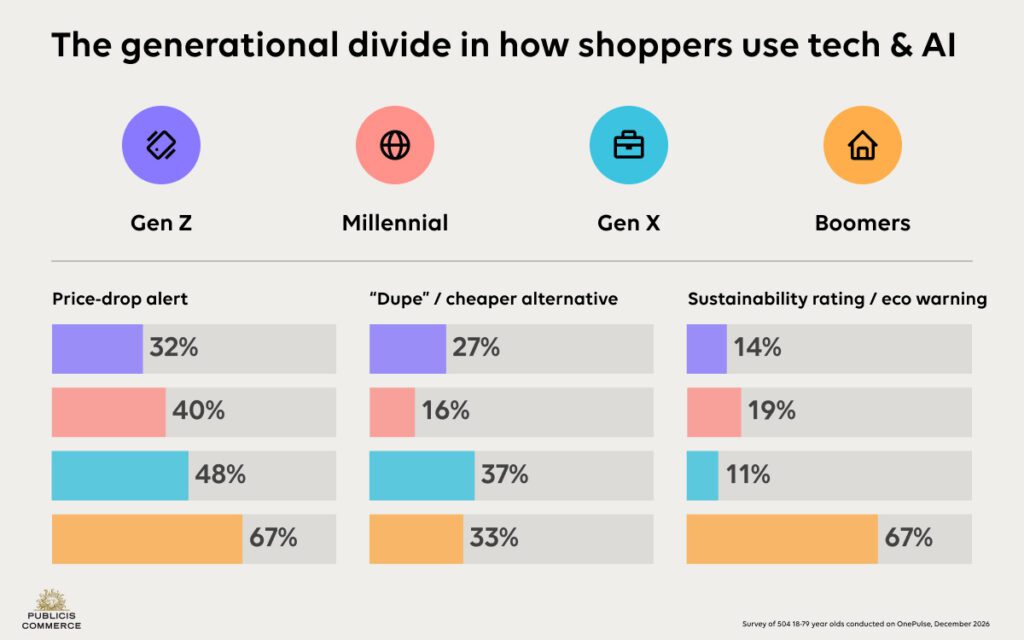
Alongside this shift in behaviour, additional research by Publicis Commerce, reveals a clear generational divide in how comfortable people feel using AI as part of shopping. Younger shoppers are far more open to using phones and AI tools to support decisions, while older shoppers remain more cautious and habit-led.
However, among those who do use AI, 95 percent of Millennials and 95 percent of Gen Z say they feel comfortable using it, compared to 85 percent of Gen X users and 100 percent of Boomers.
Among shoppers who do not use AI at all, resistance rises steeply with age, with 43% of Boomers saying they do not feel comfortable using AI in any situation, compared with 27% of Millennials.
Non-AI users would still be open to the idea of using AI for grocery tasks in the future.
Chris, 59, from Market Bosworth, said: “If we could have something that automatically checks your pantry and fridge and tells you what you need to restock – because let’s face it, a lot of us are creatures of habit, we know what we like, we get the same things week on week (you might change occasionally, but predominantly the staples don’t change very much) – it would take the drudgery out of “oh, have we got any beans in…let’s have a look in the cupboard then’. I’d certainly be up for that.”
These differences are not just about technology, but about how people approach shopping more broadly. Younger shoppers are more likely to use AI for ideas, inspiration and comparison, while older shoppers tend to rely on familiarity and routine.
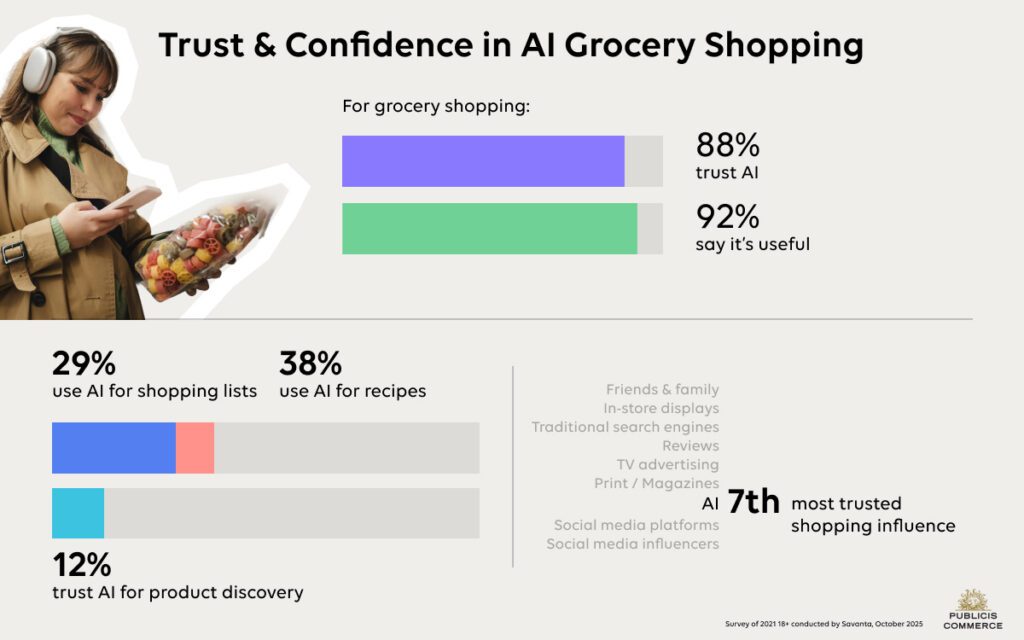
Trust in AI remains uneven across the population. While 59% of shoppers say they have used AI recently, only 49% trust it for grocery decisions overall. But confidence rises sharply among those who actively use AI for grocery tasks, with up to 92% saying it is useful and 88% say they trust it, suggesting experience plays a major role in shaping trust.
Bonnie, 33, from Hertfordshire, said: “I trust it and if it ever gives me the wrong information, like American measurements, I just tell it to give me the correct format.”
Where AI is trusted most is in planning and organisation. The research shows most shoppers use AI for recipes (38%) and shopping lists (29%), indicating comfort when AI helps narrow choices and save time.
Harley, 25, from Sheffield, said: “I use it for things like finding a recipe and then building on the recipe. I’ll ask ‘can you find me a recipe without oregano?’, because I can’t eat oregano.
“I also check in store a lot because my daughter has a milk allergy. I tend to get a lot of vegan food, but I found that a lot of vegan products are really processed. So I use an app that rates food and helps me find in-store alternatives to vegan products without animal milk.”